Insurance policy review: what Policy Call does in the meeting
An insurance policy review from Policy Call is a paid meeting. See what each plan covers, what it costs, and what the meeting will not promise.
The hospital bill arrives, and the payout is smaller than you were told. Or a plan sits in a file because the commission was higher on that one, or because a bank added it during a visit about your account.
An insurance policy review is a reading of the cover before that moment. Policy Call, at policycall.in, charges for the meeting. The published line is plain: from ₹499 for a 20-minute meeting, and the fee is for the meeting.
What the meeting is
Policy Call is a consultation. You send a few details, or the policy paper, before the call. The meeting then answers three things: what the policy pays, what the money is for, and what it will not pay. If the cover is wrong for you, they say so.
You pay Policy Call for the reading. They do not sell you a policy in the meeting. The answer can be to leave the plan unbought, or to buy nothing further.
Hospital bills, money if someone dies, and saving are three different needs. A health policy is for the hospital bill. A life policy is for the family after a death. A savings policy is money set aside. Treat a savings policy as the hospital cover, and you can keep paying while the bill sits outside what that document pays. The portfolio meeting names that mix.
What an insurance policy review looks at
The reading stays with your papers, or with the kind of cover you are about to buy. Policy Call does not publish a list of the “best 20 plans.”
If you already hold cover, the review takes up to two policies and reads office cover and home cover as one set. It names gaps, and it names overlap. Overlap is two policies paying toward the same event. A gap is an event neither policy pays.
If you have not bought yet, bring no papers. The fresh-policy meeting is about the kind of cover: health, life, or both, for you alone or for the family. Choose that kind before the form is signed.
A health insurance review and a life insurance review can sit in the same meeting when you ask for both. They stay separate needs. The meeting says which document answers which event.
The four meetings
Each price below is the fee on policycall.in for one meeting. Custom work is quoted before you pay.
| Meeting | Fee | What you bring | What the meeting returns |
|---|---|---|---|
| Fresh policy | ₹499 | No policy papers. One person or a family. | The kind of cover to choose before you buy: health, life, or both. |
| Policy review | ₹599 | Up to 2 existing policies. | Whether they fit. Office and home cover read as one. Gaps and overlap named in plain words. |
| Portfolio | ₹999 | 2 to 5 policies. | The set read together: health, life, and savings. Too little, too much, or overlap. |
| Custom | Quoted before you pay | More than 5 policies, or a mix the rows above do not cover. | A fixed price in reply. You decide before paying. |
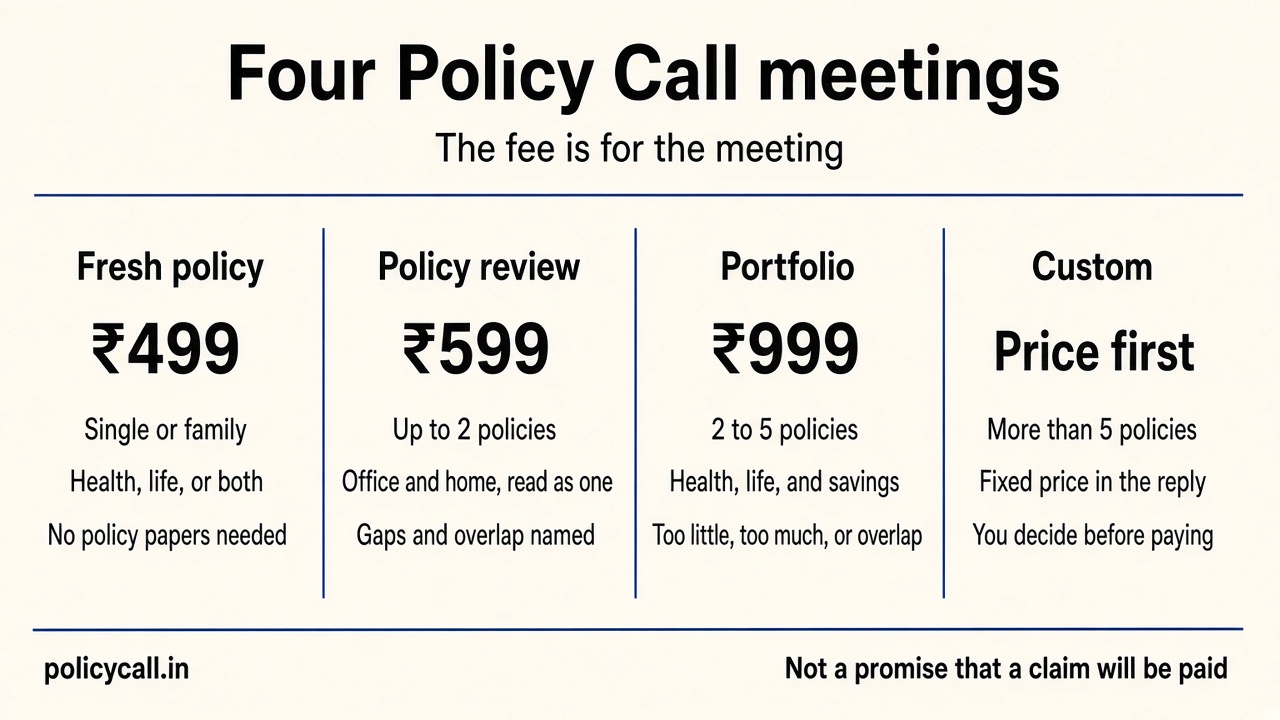
Two policies can fit either the ₹599 review or the ₹999 portfolio. Use the review when the question is office cover plus home cover, and you want gaps and overlap named. Use the portfolio when health, life, and savings need to be read as one set, and the question is whether the set is too small, too large, or paying twice.
A first health plan for a family, with nothing bought yet, is the ₹499 fresh-policy meeting. More than five policies, or a combination those three rows do not match, is custom. You describe what you hold. Policy Call replies with a fixed price. You accept that price or you walk away. Nothing is charged before the price is set.
Which meeting matches a real drawer of papers
These are illustrations, not client stories. They show how the published rows map to a set of papers.
A couple with no policy yet, choosing health cover for themselves and a child, has nothing to upload. That is the fresh-policy meeting at ₹499. The question in the room is the kind of cover, health or life or both, before anyone signs a form.
Someone with health cover from the office and a second health policy bought at home already has two documents. That is the ₹599 review. Office and home are read as one. The meeting names where they overlap and where an event falls through both.
A household with a health policy, a life policy, and a savings policy, three documents in all, is inside the portfolio range of two to five. That meeting is ₹999. Health, life, and savings are read together, and the answer is whether the set is too small, too large, or paying twice for one event.
Six policies, or a mix the three priced rows do not cover, is a custom meeting. You write down what you hold. Policy Call sends a fixed price. You pay only after you accept it.
Why the fee is the product
An insurance agent sells the plan that pays a higher commission. Policy Call calls that misselling. The commission decides which plan is pushed. You pay the premium either way. The agent earns more on the plan that suits the agent.
A bank can add a policy during a visit that was about your account. You did not ask for it. The premium still leaves the account.
The meeting fee means the meeting is not funded by a sale. Policy Call confirms that you have paid, then reads, then meets. Sometimes the answer is “do not buy this.”
A sale that already went wrong is a complaint, and it has its own path. Write to the insurer’s grievance officer. If that does not resolve it, register on Bima Bharosa. Policy Call does not lodge that complaint for you. The meeting reads the wording. Complaints still go to the insurer. Details: How to make a complaint.
How a meeting works
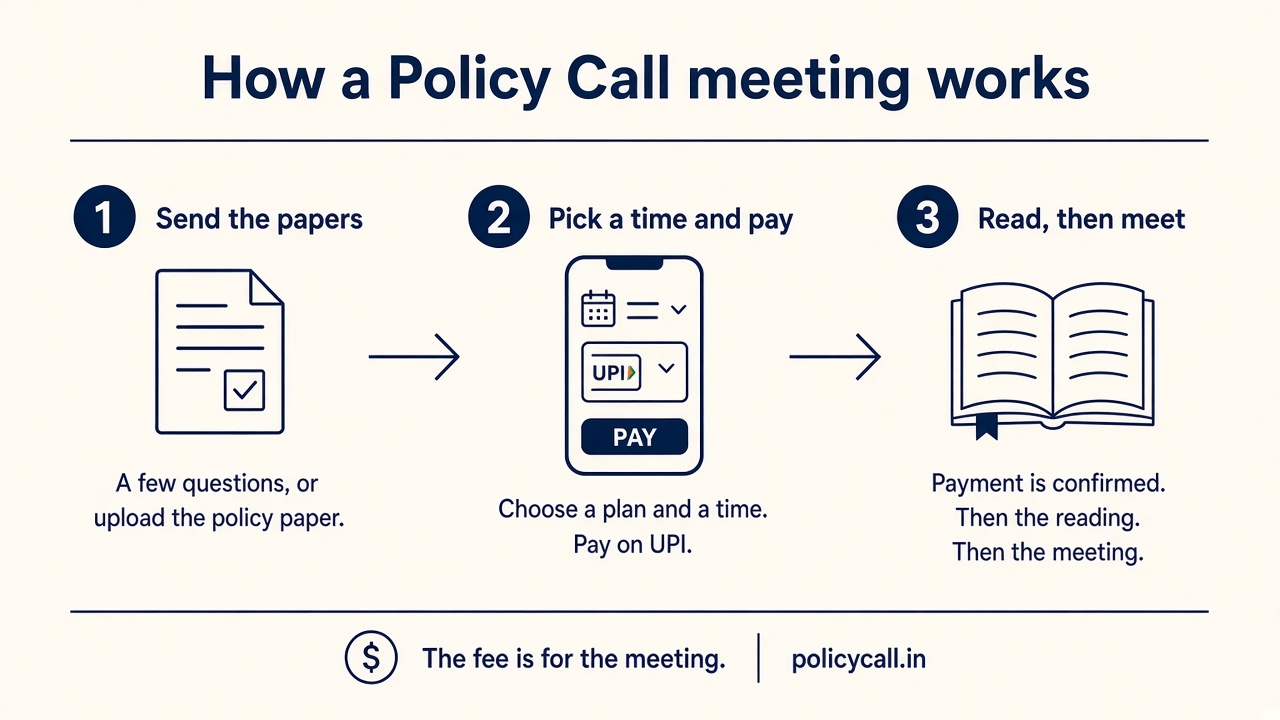
- Answer a few questions, or upload the policy paper.
- Pick a plan and a time. Pay on UPI.
- Policy Call confirms the payment. Then they read. Then you meet.
Papers and details go in first. The call is kept for the answer, not for collecting files.
What the meeting will not do
Policy Call will not promise that a claim will be paid. A reading of the wording is not a settlement letter. The insurer still decides the claim against the document, the bills, and the exclusions printed in the policy.
The meeting will not push you to buy before you leave.
It will also not tell you to cancel in a rush, or to drop office cover. Cover from an employer and a policy you bought yourself can answer different events, and sometimes the same event with different caps. Drop the office plan because a call felt decisive, and you can open a gap the personal policy does not fill. The review names that gap. The decision to cancel stays with you.
A savings policy in the set is not an investment recommendation. The portfolio meeting says how it sits beside health and life. It does not forecast what that savings portion will be worth.
Questions people ask before they book
Is Policy Call selling the insurance?
The fee is for the meeting. Policy Call does not sell you a policy in that meeting. You can be told the cover is wrong for you.
How much does an insurance policy review cost?
A fresh-policy meeting is ₹499. A review of up to two existing policies is ₹599. A portfolio of two to five policies is ₹999. Anything outside those rows is priced before you pay. The public line on the site is from ₹499 for a 20-minute meeting.
Do I need the policy papers?
For a fresh policy, no. Nothing has been issued yet. For a review or a portfolio, upload the papers or answer the questions before the call, so the meeting can be spent on the reading.
Can the meeting guarantee a claim?
No. Policy Call will not promise that a claim will be paid. The meeting says what the wording pays and what it refuses. Payment of a claim stays with the insurer.
What if I hold more than five policies?
That is a custom meeting. Tell Policy Call what you hold. They reply with a fixed price. You decide before paying.
Book the meeting that matches the papers
Choosing cover, with nothing in hand, starts at the ₹499 fresh-policy meeting on policycall.in. One or two policies already issued, including office cover beside a personal policy, is the ₹599 review. A set of health, life, and savings policies, from two up to five, is the ₹999 portfolio. Send the papers before the call.
This is not investment advice. Policy Call cannot promise that a claim will be paid.